Why Voice Chat Creates Real Connection (And Text Doesn't)
Last Updated: February 2026
You have hundreds of text conversations in your phone. Group chats, DMs, threads, reactions. You communicate constantly. And yet, when you put the phone down at night, something feels hollow. You were talking all day, but you never actually talked to anyone.
This isn't a personal failing. It's a design problem. Text-based communication was built for efficiency, not connection. It's optimized for information transfer, not emotional resonance. And as our social lives have migrated almost entirely into text channels, we've inadvertently traded real human connection for something that only looks like it.
The research is increasingly clear: voice communication creates bonds that text simply cannot. Hearing another person's voice activates something deep and ancient in the brain, something no amount of emoji or punctuation can replicate. Understanding why is the first step toward building a social life that actually nourishes you.
The Science of Voice and Human Connection
We Underestimate How Good Conversation Feels
Nicholas Epley, a behavioral scientist at the University of Chicago, has spent years studying how people predict social interactions versus how they actually experience them. His research, published across multiple studies, reveals a consistent pattern: people dramatically overestimate how awkward conversations with strangers will be.
In one landmark study, Epley and his colleague Juliana Schroeder asked participants to predict how they would feel after talking to a stranger on a train. Most expected discomfort. What they actually reported was enjoyment, warmth, and a sense of connection they hadn't anticipated. Critically, these effects were strongest when the interaction was voice-based rather than text-based. Hearing a person's voice, even a stranger's, made participants rate the other person as more thoughtful, more intelligent, and more likable.
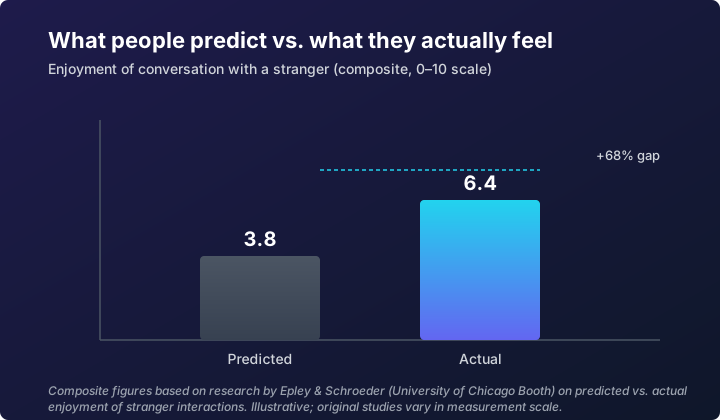
Epley's work points to what researchers call "the humanization effect." When you read someone's words on a screen, you process them abstractly. When you hear someone speak those same words, your brain registers a full human being behind them. The voice carries evidence of a mind at work, complete with hesitation, emphasis, warmth, and all the subtle textures that reveal a person thinking and feeling in real time.
Voice Conveys What Text Cannot
The human voice is an astonishingly rich channel of information. Research in affective science has identified at least 24 distinct emotions that can be reliably communicated through vocal tone alone. These include not just the obvious categories like happiness, sadness, and anger, but nuanced states like awe, interest, relief, compassion, and embarrassment.
Text has no mechanism for any of this. When someone types "I'm fine," you have no idea whether they are actually fine, quietly devastated, being sarcastic, or rushing through a reply while distracted. When someone says "I'm fine," you know instantly. The pitch, the pacing, the breath behind the words, these signals are processed by your brain in milliseconds, often before you consciously register them.
This is why misunderstandings are endemic to text communication. Sarcasm lands as sincerity. Brevity reads as coldness. Enthusiasm looks like aggression when rendered in all caps. We have tried to solve this with emoji, exclamation points, and "lol" as a tone softener, but these are crude patches on a fundamentally impoverished medium.
The Mehrabian Question
You may have encountered the statistic that 93% of communication is non-verbal. This comes from research by Albert Mehrabian in the 1960s, and it is frequently cited in ways that overextend the original findings. Mehrabian's experiments specifically examined how people interpret emotional attitude when words and tone conflict, not all communication in all contexts.
That said, the directional truth holds. When it comes to emotional communication, the kind that builds relationships and creates a sense of being understood, non-verbal cues carry enormous weight. And vocal tone is the most important non-verbal channel we have in remote communication. Remove the voice, and you strip away the primary mechanism through which humans signal empathy, sincerity, affection, and trust.
Familiar Voices Build Trust
Psychologists have long studied the "mere exposure effect," the phenomenon in which repeated exposure to a stimulus increases our preference for it. This applies powerfully to the human voice. Hearing someone's voice repeatedly, even in brief interactions, builds a sense of familiarity that accelerates trust.
This is one reason why phone calls with a friend feel qualitatively different from text threads. The voice becomes a kind of emotional anchor. You associate it with the person's full presence. Over time, the sound of a familiar voice can reduce cortisol levels and trigger oxytocin release, the neurochemical basis of bonding and trust.
Text offers no equivalent. A username, a profile picture, a typing style, these create recognition but not the visceral sense of knowing someone that voice provides.
Voice Reduces Loneliness More Effectively Than Text
The loneliness research literature has grown substantially in recent years, and one finding emerges repeatedly: the quality of social contact matters more than the quantity, and voice contact consistently outperforms text contact in reducing feelings of isolation.
This makes intuitive sense. Loneliness is not about being physically alone; it is about feeling unheard, unseen, and disconnected from others. Text can inform you that someone is thinking of you, but voice can make you feel it. The real-time, synchronous nature of voice conversation demands mutual presence in a way that texting does not. Both people are there, in the same moment, attending to each other. That shared attention is the foundation of genuine connection.
Why Text Falls Short
Text communication is not inherently bad. It is excellent for logistics, quick updates, and asynchronous coordination. The problem is that we have allowed it to become the dominant mode of social interaction, a role for which it is poorly suited.
Text Encourages Performance Over Authenticity
When you text, you edit. You draft, revise, delete, and carefully construct the version of yourself you want to present. This self-editing instinct is not entirely conscious, but it is pervasive. The result is a mode of communication that rewards performance over authenticity.
Voice conversation, by contrast, happens in real time. You cannot unsay a word. You stumble, you pause, you laugh at yourself. This imperfection is not a bug; it is the mechanism through which vulnerability and genuine personality emerge. The unedited quality of voice is precisely what makes it feel real.
Text Is Easy to Ignore
A text message sits patiently in a queue until you choose to engage with it. You can leave it on read. You can reply hours later with a carefully crafted response. This asynchrony is convenient, but it also means that text interactions carry little inherent commitment.
Voice demands presence. When someone is speaking to you, you are there, or you are not. This is not a burden; it is what makes voice conversations feel meaningful. The mutual investment of attention is itself a form of care.
Text Creates Distance
There is a paradox at the heart of text communication: the more words you exchange, the more you can feel like strangers. Text collapses complex human beings into flat strings of characters. Without vocal tone, facial expression, or the rhythm of real-time exchange, people become abstractions. It is easy to be cruel in text, easy to be dismissive, easy to forget that there is a living person on the other end.
Voice reverses this. The moment you hear someone's voice, they become undeniably human. This is Epley's humanization effect in action, and it has profound implications for empathy, kindness, and the depth of connection we are able to build through technology.
Why Voice Is the Sweet Spot
If voice is better than text, why not go further? Why not video?
Video has its place, but for everyday social connection, voice occupies a sweet spot that video overshoots.
Less Anxiety, More Openness
Video calls introduce a layer of self-consciousness that voice eliminates. On video, you are aware of your appearance, your background, your lighting. You are performing for the camera while simultaneously trying to connect with another person. Research on video fatigue, sometimes called "Zoom fatigue," has documented the cognitive toll of this dual awareness.
Voice removes the visual performance entirely. You can talk while walking, while cooking, while lying on your couch in whatever state you happen to be in. The freedom from visual judgment makes people more open, more relaxed, and more willing to be themselves.
Naturally Ephemeral
Text creates a permanent record. Every message you send is logged, searchable, and screenshottable. This permanence changes what people are willing to say. You become cautious. You self-censor. You hold back the raw, unpolished thoughts that are often the most interesting and most connecting.
Voice conversation is naturally ephemeral. Words are spoken and then they are gone. This impermanence creates a psychological safety that encourages honesty. People say things in voice that they would never commit to text, not because those things are scandalous, but because they are vulnerable.
Compatible With Real Life
You cannot text while driving (or shouldn't). You cannot easily text while cooking, walking, or doing chores. Voice fits seamlessly into the flow of daily life. A voice conversation can accompany you through your evening routine in a way that text never can. This accessibility matters because the biggest barrier to social connection is not desire but friction. The easier it is to connect, the more often people actually do it.
The Discord Problem
Discord is the dominant social platform for many online communities, and it has done genuinely impressive work in building spaces where people can gather. But Discord has a structural bias toward text that undermines its potential for real connection.
Most Discord servers are overwhelmingly text-based. Voice channels exist, but they are secondary. The typical user experience is scrolling through text channels, reading messages, reacting with emoji, and occasionally typing a reply. Voice channels sit empty in most servers, most of the time.
The result is a platform where people feel "connected" to a community but are actually just consuming and producing text. You can spend hours on Discord and never hear another human voice. You can be an active member of a server for months and have no idea what the other members sound like.
This is not connection. It is proximity without presence.
A voice-first model flips this dynamic entirely. When voice is the default, not the exception, actual conversation happens. People talk. They laugh. They share silence. They experience the full bandwidth of human communication instead of its narrowest channel.
Frequently Asked Questions About Voice vs Text
Isn't text better if you're shy or anxious?
For starting, often yes — and it is worth being honest that voice asks more of you up front. Text lets you draft, delete, and answer when ready, which is a real accommodation and not a lesser form of contact. The trade is that the same buffer that lowers the cost of speaking also removes the cues that make someone feel heard, and the reassurance you get back is correspondingly thinner. Many people find voice easier with a stranger than with someone they know, precisely because there is nothing at stake.
Is voice harder across a language barrier?
Yes, noticeably. Text is forgiving — it can be reread, translated, and answered slowly — while voice runs at conversational speed with accents and no subtitles. This is one of the clearest cases where text is the better tool, and pretending otherwise helps nobody. Voice rewards shared fluency; where that is missing, the gap is not a matter of confidence.
Why is voice more tiring than messaging?
Because it is synchronous and unbuffered. Text is a queue you drain when you choose; a call holds your attention continuously, and you are producing and interpreting at the same time with no pause to compose. That density is exactly what makes half an hour of talking feel like more contact than a day of messages — the cost and the benefit are the same property.
HereSay: Voice-First by Design
This is the philosophy behind HereSay. We built a platform where voice is not a feature bolted onto a text interface. It is the entire point.
HereSay is anonymous voice chat with no sign-up required. You arrive, you talk, you connect. There are no profiles to curate, no text channels to scroll, no performance to maintain. Just your voice and someone else's, in real time, with nothing in between.
The anonymity is intentional. Without the baggage of identity, profile pictures, and social history, conversations start from a place of equality and openness. You are not judged by your follower count or your avatar. You are heard for what you say and how you say it.
This is what technology should do: reduce the friction between people who want to connect and the connection itself. Not add layers of text, notifications, and performance metrics between them.
Try It
If you have been feeling like your digital social life is busy but empty, the fix might be simpler than you think. Stop typing. Start talking.
Visit heresay.live and have a real conversation. No account needed. No camera required. Just your voice and someone ready to listen.
The research says voice creates connection. Your experience will confirm it.
Part of: Voice Chat Alternatives — A Complete Guide for 2026. This post is one of the spoke articles in our voice chat alternatives content cluster; see the pillar for the full taxonomy and decision framework.
Keep reading
-
Voice Chat for Connection: Why Audio Beats Text
Voice chat offers something text messaging can't — real human connection. Why audio-first communication helps loneliness and how to make it work.
-
Voice Chat vs Video Chat: Why Audio-First Wins
Video call fatigue is real—but does that mean we should go back to text? Research suggests voice chat offers the best of both worlds for human connection.
-
Rise of Voice Dating: Why Hearing Someone Beats Seeing Them
Voice dating is having a moment. Research shows we judge compatibility better by voice than by photos. Here's why hearing someone is the future of dating.
-
Technology and Changing Connection
Technology has transformed how we connect—for better and worse. Understand the impact and learn how to use tech to enhance rather than replace real…